
Moving to Norway: Housing options & real estate market for expats
Finding the perfect apartment is often the first major hurdle for newcomers when moving to Norway. The Norwegian property market – especially in metropolitan areas – is highly competitive: rents in the four largest cities rose by 3.4 percent year‑on‑year in the first quarter of 2026, and by 7.9 percent over the last four quarters. Unlike in Germany, where the rent brake only applies in tight markets and limits rent to a maximum of 10 percent above the local comparative rent, Norway generally follows a more liberal market model. This guide provides you with a comprehensive overview of the various housing options, the most important legal framework of the Norwegian rental market, as well as a current rental price overview of the main cities, to help you make your decision.
RENTAL APARTMENTS IN NORWAY: REGIONAL DIFFERENCES AND TYPICAL FEATURES
Rental prices in Norway vary greatly by region: Oslo is by far the most expensive city, followed by Bergen and Trondheim, while rural regions such as Innlandet or Nordland offer significantly more affordable alternatives. Unlike in Germany, where rent regulation applies nationwide and rent in many cities is measured against the local comparative rent, the Norwegian rental market is more liberalised. There is no general rent brake; only for older apartments with a simple standard can tenants request a judicial review. When searching for accommodation, you should also keep an eye on utility costs – electricity prices in Norway vary by region, and the cold season can significantly drive up heating costs.
ALTERNATIVE HOUSING OPTIONS
In addition to classic rental apartments, the following alternatives in Norway can make the start easier:
– FURNISHED APARTMENTS: Particularly for a short‑term start, furnished apartments are a time‑saving solution. Furnished apartments in Norway achieve a noticeable price premium, especially among expats, although the majority of long‑term tenants still prefer unfurnished apartments.
– SERVICED APARTMENTS: In Oslo, Bergen and Trondheim, there are providers offering apartments with flexible lease terms as well as additional services such as cleaning and laundry service – ideal for expats with company support.
– SHARED FLATS: A popular and budget‑friendly option, especially among young professionals and students. In Oslo, a private room in a shared flat costs between 6,000 and 10,000 NOK per month.
– BUYING A HOME: For those staying in Norway permanently, buying a property can be an attractive option. EU citizens can generally purchase property without restrictions. Unlike in Germany, where even foreigners without a fixed residence can freely buy property, real estate agents in Norway often require a Norwegian D‑number (temporary identification number) in practice. An important difference from Southern Europe: buying a property does not entitle you to a residence permit in Norway.
– COOPERATIVE HOUSING (BORETTSLAG): A special feature of the Norwegian housing market is the borettslag – a housing cooperative where you purchase shares in the cooperative, not the apartment itself. You acquire a right of use (andelsrett) and pay a monthly contribution to the cooperative. This form of housing is often cheaper than buying a condominium, but comes with more restrictions, for example regarding subletting.
HOUSING COSTS: RENTAL PRICES IN OSLO, BERGEN, TRONDHEIM AND OTHER CITIES
Rental prices in Norway vary greatly by region. Here is a current overview of average monthly rental prices (as of 2026):
Oslo remains by far the most expensive city in Norway. Rental prices for a one‑bedroom apartment in the city centre are about 15,000 to 22,000 NOK per month, on average about 18,000 NOK (approx. 1,500‑1,550 euros). A comparable apartment in a central location in Munich, Hamburg or Frankfurt is relatively similarly expensive, although salaries in Norway tend to be higher. In central and sought‑after districts such as Frogner, Majorstuen, Grünerløkka and Torshov, prices are highest, while slightly cheaper alternatives can be found in Groruddalen or Søndre Nordstrand.
Bergen, the second largest city in Norway, offers a good mix of quality of life and affordability. A one‑bedroom apartment in the city centre costs between 10,000 and 16,000 NOK per month. Popular districts are the historic Bryggen, lively Nordnes and the student area of Nygård.
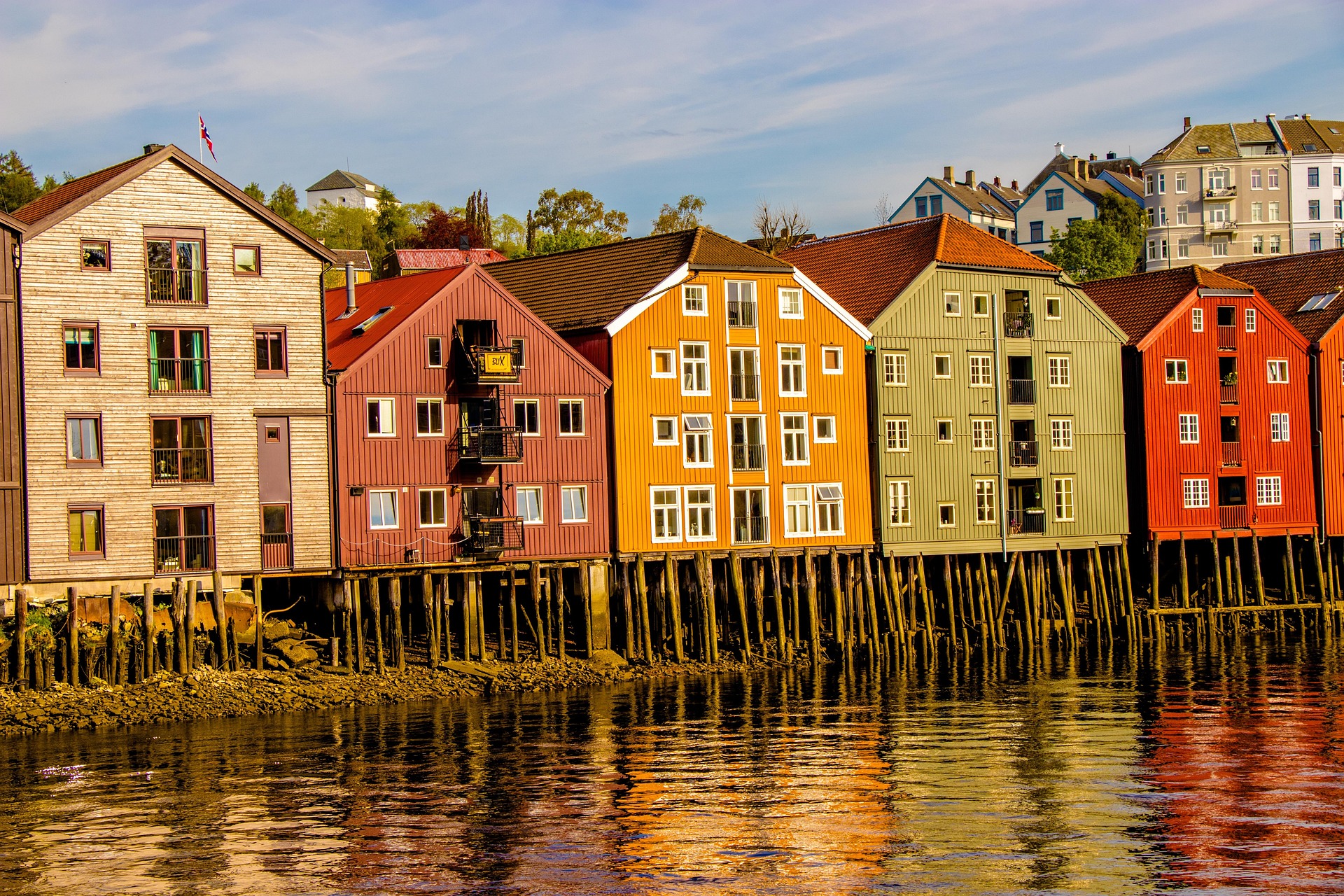
Trondheim, the third largest city, is known for its university and technology scene. A one‑bedroom apartment in the city centre costs between 9,000 and 15,000 NOK per month. Popular residential areas are Bakklandet with its wooden houses, central Midtbyen and quiet Lerkendal.
Stavangerin southern Norway is a centre of the oil industry. Here, a one‑bedroom apartment in the city centre costs about 9,000 to 14,000 NOK per month.
In smaller towns and rural regions, rental prices are even cheaper at 5,000 to 8,000 NOK per month for a one‑bedroom apartment – here Norway differs little from Germany, where rents in the countryside are also significantly lower.
In addition to the base rent, monthly utility costs (strøm, oppvarming, vann) for heating, electricity, water and internet are payable – about 1,500 to 3,000 NOK extra per month. In the cold season, heating costs can rise significantly, which is a major difference from Germany, where many apartments have central heating included in the utility costs. A flat‑rate internet connection costs about 400‑600 NOK per month. Utility costs are often paid as a separate advance payment and later settled based on actual consumption.
IMPORTANT LEGAL AND FINANCIAL ASPECTS OF TENANCY LAW
DEPOSIT (DEPOSITUM): In Norway, the landlord can legally demand up to three months' rent as a deposit – this is similar to German regulations. However, the deposit must be paid into a separate blocked account (depositumskonto) with a bank, which is in the tenant's name, and which the landlord can only access for justified claims. A major difference from Germany: without such a blocked account, the deposit is invalid, and the tenant can refuse payment. For an apartment with 15,000 NOK rent, this is up to 45,000 NOK due before moving in.
NOTICE PERIODS: The statutory notice period for tenants for indefinite leases is generally three months to the end of the month. For landlords, the notice period is also three months, and a valid reason must exist – for example, own use or default in payment. Compared to Germany, where the notice period for landlords can increase to up to nine months depending on the length of the tenancy, the Norwegian regulations are less strict for tenants.
FIXED‑TERM LEASES: In Norway, fixed‑term leases are generally permitted for up to three years. Unlike in Germany, where a fixed term is only possible with a valid reason (e.g., the landlord's own use after the term), in Norway a fixed‑term contract can be agreed that automatically ends without requiring notice. If the fixed term is invalid, the contract is considered indefinite.
PROOF OF INCOME: Norwegian landlords generally require proof of income (the last three payslips) as well as proof of identity. The Norwegian D‑number or Norwegian bank account details are often helpful. The deposit must be repaid in full upon moving out, less documented damage beyond normal wear and tear. In case of disputes, the Rent Disputes Tribunal (Husleietvistutvalget) or the district court decides.
Conclusion
Moving to Norway requires careful preparation regarding apartment search, regional differences and legal framework. The real estate market is highly competitive in metropolitan areas such as Oslo, Bergen and Trondheim – rents have risen continuously in recent years. However, those willing to move to smaller towns or rural regions can find significantly more affordable housing, similar to Germany. A major difference from Germany: the mandatory D‑number for almost all official procedures and banking transactions is a bureaucratic hurdle that must be addressed early. From a financial perspective, Norway is expensive by European comparison – however, the high price level is generally compensated by higher salaries.
Our Norway moving service includes the following services:
- Export packaging of furniture
- Packing work complete
- Provision of packaging for overseas shipments
- Furniture dismantling
- Creation of a loading list with a number for each item
- Complete customs clearance export
- Container loading at your premises or pre-collection to our warehouse - depending on the situation
- Transportation from home/warehouse to port
- Sea freight from port to port
- Complete customs clearance import
- Transportation from port to home
- Unpacking the furniture
- Furniture assembly
- Disposal of packaging materials on the day of unloading
- Unpacking of the boxes on request - will be charged separately according to expenditure
- Terminal handling fees at the destination
- Return of the empty container to the port/terminal
KOCH Moving Logistics Ltd. offers both comprehensive service packages and individually bookable moving services for international moves to Norway. Additional services are also available upon request. Just ask us!
Based on the information you provide, we will prepare a customized and transparent offer.
Your relaxed move abroad
As a German company with over 120 years of experience, we know the special features that need to be considered when moving and ensure that your move goes quickly and smoothly.
Our moving company provides you with state-of-the-art equipment and high-quality packaging material to protect your valuables and furniture in the best possible way during transportation.
As one of the most successful moving companies in Germany, we offer you a first-class service at competitive prices. We understand that every move is unique and that's why we offer customized solutions tailored to your individual needs. Come and see us, KOCH Moving Logistics, our movers and our services for for yourself - and you will soon be one of our many satisfied regular customers.
Arrange a visit with one of our customer advisors.
Arrange an appointment with one of our customer advisors. We will be happy to visit you and provide you with a detailed quote for your moving to Norway that fits.
If you need advice or have any questions, please contact us in Osnabrück on the following telephone number 0541 – 121 68 50.
Make an express request now!
Simply fill out our inquiry form and you will receive a non-binding offer for your move. Our competent consultants will visit you on site or plan the move with you by phone.
Your contact for international moves